Purpose
The integrating sphere, commonly known as the Ulbricht Sphere (or Ulbricht-Kugel in German), is a fundamental optical instrument. It is designed to capture, diffuse, and measure electromagnetic radiation—typically visible light. This article covers its origin, working principles, applications, and core mathematical foundation.
History & Definition
Invented by German engineer Richard Ulbricht in 1900, the Ulbricht Sphere is a hollow spherical cavity with a highly reflective, diffuse, white interior coating. Its key property is its ability to scatter light rays uniformly in all directions, regardless of the light source's initial spatial distribution.
- Key Property: Spatial integration of light.
- Interior Surface: Covered with a Lambertian reflector (e.g., Barium Sulfate or PTFE/Spectralon).
How an Integrating Sphere Works
When light enters the sphere through an input port, it strikes the diffuse inner coating and undergoes multiple Lambertian reflections. By the time the light reaches the output port or detector, all directional information has been completely randomized, resulting in a perfectly homogeneous light field inside the cavity.
- Lambertian Coating: A surface that reflects light such that the apparent brightness of the surface is the same regardless of the observer's angle of view.
- Baffles: Internal shields used to prevent direct, unreflected light from travelling from the source to the detector.
--- Integrating Sphere Design ---
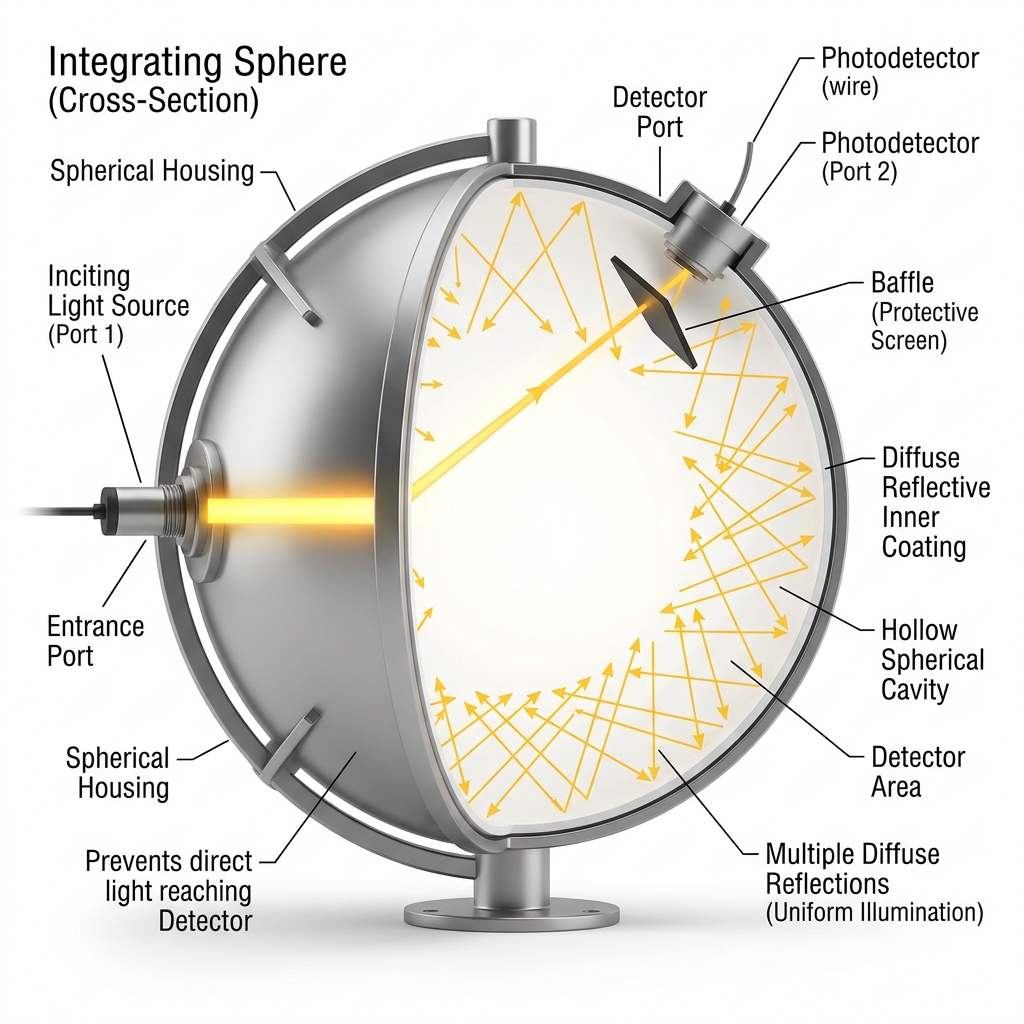
Integrating Sphere (Ulbricht-Kugel) Cross-Section Diagram
Applications
Integrating spheres are widely used across physics, engineering, and calibration workflows:
| Measurement / Setup | Description |
|---|---|
| Luminous Flux | Measuring the total light output of lamps, LEDs, and lasers in all directions. |
| Reflection & Transmission | Determining how much light a material reflects or lets through at various angles. |
| Sensor Calibration | Creating a uniform light source to calibrate camera sensors, spectrometers, and photodetectors. |
| Laser Power Measurement | Attenuating high-power laser beams safely to measure total optical power. |
Mathematical Foundation
The irradiance $E$ at any point on the sphere wall produced by an input flux $\Phi_i$ is determined by the sphere's parameters:
$$E = \frac{\Phi_i}{A_s} \cdot \frac{\rho}{1 - \rho (1 - f)}$$
Where:
- $E$ is the sphere wall irradiance, measured in Watts per square meter ($\text{W/m}^2$) or lumens per square meter ($\text{lm/m}^2$, also known as lux).
- $\Phi_i$ is the initial input radiant flux (in Watts, $\text{W}$) or luminous flux (in lumens, $\text{lm}$).
- $A_s$ is the total inner surface area of the sphere ($4\pi R^2$), measured in square meters ($\text{m}^2$).
- $\rho$ is the reflectance of the internal coating (dimensionless, typically a fraction between 0.95 and 0.99).
- $f$ is the port fraction (dimensionless ratio of the total area of all ports to the total sphere surface area).
This shows that high reflectance $\rho$ and low port fraction $f$ greatly increase the sphere's efficiency and spatial integration capabilities.
Conclusion
The Ulbricht Sphere remains an indispensable tool in radiometry and photometry. From calibrating advanced CMOS sensors to measuring the efficiency of consumer LED bulbs, its simple yet elegant geometric properties provide the ultimate reference for spatial light integration.